Avenue Decor
Can WPC outdoor decking be used around swimming pools? Yes, but the answer depends on the product, installation, and pool environment. Wood-plastic composite decking is widely used beside residential pools because it resists rot, insects, and frequent water exposure. It also avoids splinters when properly manufactured and maintained. However, not every WPC board is suitable for wet feet.
As building-materials specialist Brett Miller explains, “Around a pool, performance matters more than appearance.” That principle guides this review of China’s top 10 WPC decking products for swimming pools. Each option should be examined for slip resistance, drainage design, surface temperature, dimensional stability, and fastening quality. A textured surface can improve grip, while hidden gaps help rainwater and splash water escape. Dark boards may become uncomfortable under strong summer sunlight. Light colors are not automatically safer.
The strongest products should also provide clear test data and installation instructions. Look for capped WPC, UV-resistant pigments, stainless-steel clips, and adequate subframe spacing. The surrounding ground matters too. Poor drainage can leave water beneath the deck, even when the boards are excellent. No decking is maintenance-free. Occasional cleaning remains necessary, especially near chlorine, sunscreen, and fallen leaves.
This ranking is useful, but it is not absolute. A product performing well in a dry Chinese climate may behave differently beside a coastal pool. A wet-foot test still matters. So does local installation experience. The best choice balances safety, comfort, appearance, warranty support, and realistic maintenance expectations. Sometimes, the most attractive board is not the wisest one.
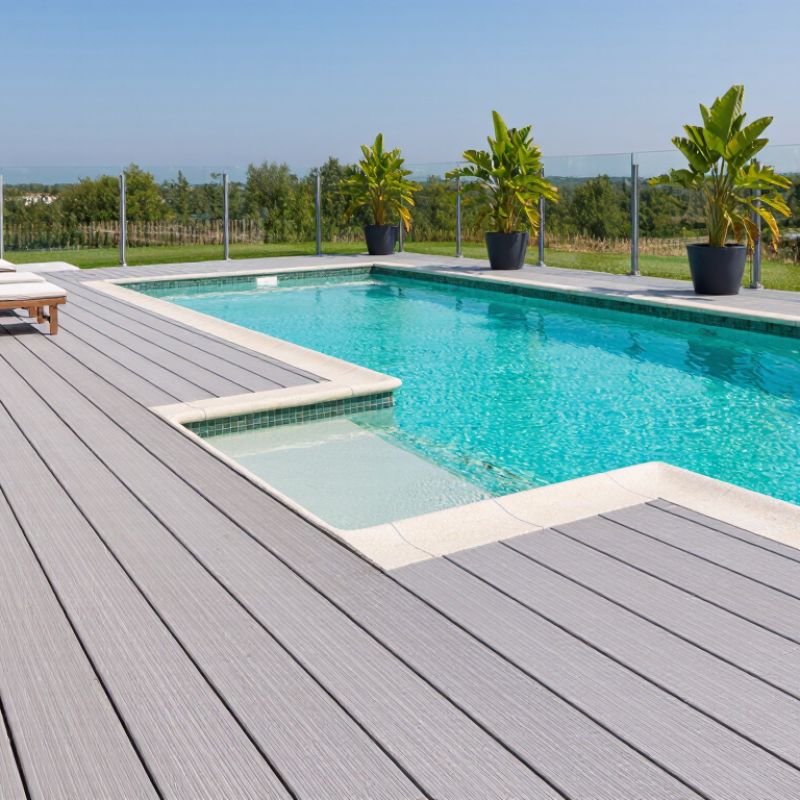
What Makes WPC Decking Suitable for Swimming Pools
WPC decking combines wood fibers with recycled polymer, creating a surface suited to wet outdoor areas. Its low water absorption helps reduce swelling, cracking, and decay around pool edges. However, WPC is not completely waterproof. Water can still enter through cut ends, joints, and poorly sealed fasteners.
A pool deck needs more than moisture resistance. A textured surface can improve grip when swimmers leave the water with wet feet. Proper drainage matters too. During installation, narrow gaps allow rain and splash water to escape, while a stable substructure limits movement. I have seen boards remain attractive, yet become uncomfortable under strong summer sunlight. Lighter colors usually feel cooler, but local climate testing remains important.
Chlorine splashes, sunscreen, and fallen leaves can stain the surface if ignored. Routine cleaning with mild soap and fresh water is usually practical. Avoid harsh chemicals unless the supplier confirms compatibility. For reliable selection, request documented results for slip resistance, water absorption, UV stability, and load performance. Product quality can vary considerably among manufacturers. A cheaper board may look convincing at delivery, but its long-term color retention and edge strength still need careful verification.
Poolside boards face more than rain. They meet chlorinated water, sunscreen, bare feet, and strong afternoon sun. Check wet-slip test results, and confirm they apply to the exact board profile. A dry showroom sample tells little. Small details matter.
Ask for water-absorption data, UV-weathering results, and clear limits for temperature and chemical exposure. WPC formulas vary, so the term alone does not guarantee long service life. Request installation guidance too: joist spacing, clip type, drainage gaps, and expansion allowances all affect performance.
A narrow gap can trap leaves and slow drying. On a hot day, darker boards may also feel uncomfortable underfoot.
Compare the full system, not just the board price. Review the substructure, edge trims, and replacement availability. If the supplier cannot explain test methods or provide consistent product specifications, pause and ask again.
That can feel tedious. It is still cheaper than removing warped boards later.
Even strong test data cannot predict every pool’s maintenance routine or local climate, so inspect a sample after wetting and cooling it outdoors.
China’s Top 10 WPC Decking Options for Swimming Pools include capped co-extruded boards, solid-core boards, hollow boards, brushed-surface boards, embossed wood-grain boards, UV-stabilized boards, low-absorption boards, anti-slip boards, recycled-content boards, and custom-profile boards. Each option suits different pool conditions. Capped boards resist stains and chlorine splashes well. Solid boards feel stable under heavy furniture. Hollow boards reduce weight, but their edges need careful sealing.
In real pool projects, I check drainage, surface texture, thermal movement, and installation spacing. A finely brushed surface can improve wet-foot grip without feeling too rough. UV stabilizers help slow fading under strong sunlight. However, darker decking may become uncomfortable during summer afternoons. That detail is easy to overlook. I also inspect test reports for water absorption, slip resistance, and flexural strength. Supplier claims alone are not enough.
For coastal pools, corrosion-resistant clips and stainless-steel fasteners matter. Around children’s pools, smooth edges and consistent gaps deserve close attention. Recycled content can support a lower-impact specification, but performance data must remain clear. No board is perfect. I once preferred a hollow profile for easier handling, then reconsidered it after seeing water collect inside poorly finished ends. Experienced installers should review the subframe, ventilation, and local climate before choosing among China’s top ten WPC decking options.
China Top 10 WPC Decking for Swimming Pools?
When comparing ten WPC decking options for swimming pools, safety should lead the review. The U.S. Consumer Product Safety Commission reported about 6,300 annual nonfatal pool submersion injuries among children under 15 during 2020–2022. Decking cannot prevent drowning, but it can reduce falls around wet edges. Look for textured surfaces, stable installation, rounded board profiles, and tested slip performance. ASTM D7032 also provides a useful reference for evaluating composite decking strength and durability.
Durability depends on more than a capped surface. Repeated splashing, chlorine, sunscreen, heat, and winter freezing can expose weak board structures. Compare water absorption, thickness swelling, fastener holding, and color retention data. Grand View Research identifies moisture resistance and reduced maintenance as major drivers in the global WPC market. Still, marketing language is not laboratory evidence. Ask for test reports, installation limits, and warranty exclusions.
Design affects maintenance too. Light gray boards usually show less dust than deep brown finishes, while narrow gaps help drainage but collect debris. A 2023 U.S. EPA report emphasizes that routine cleaning supports safer outdoor surfaces, although it does not replace proper drainage. I have seen attractive boards become slippery when algae formed in shaded corners. That detail is easy to miss. Inspectors should check joist spacing, ventilation, standing water, and board movement after installation. Even the best product can fail when the substructure is poorly planned.
Installation and Care Guidelines for WPC Pool Decking
A stable substructure is the foundation of safe WPC pool decking. Install joists on a firm, level surface with enough drainage beneath them. Standing water can damage supports and encourage algae growth. Follow the decking supplier’s spacing requirements, especially around pool edges and steps. Use corrosion-resistant fixings suitable for wet environments. Leave expansion gaps at board ends and sides, because heat can make composite boards move. Measure twice.
Keep the surface slightly sloped away from the pool. This helps water escape after swimming or heavy rain. Do not seal drainage channels with concrete or adhesive. Allow air to circulate under the deck. Tight spacing may look neat, but it can trap moisture and debris. That was a mistake I would not repeat on a humid site.
Sweep leaves and sand regularly with a soft broom. Rinse chlorine or salt residue with clean water after busy swimming days. For stains, use mild soap and a soft brush; avoid aggressive solvents and metal tools. Check screws, clips, joists, and handrails at least twice each year. Replace damaged boards promptly. WPC needs less maintenance than timber, not zero maintenance. Dark colors may also become hot under direct sunlight, so barefoot comfort deserves a practical test before installation.
The options below are generic WPC decking configurations, not a brand ranking. Dimensions and construction vary by manufacturer; confirm product-specific specifications, installation instructions, and suitability for wet areas before purchase.
| No. | Generic Decking Option | Representative Board Dimensions | Poolside Suitability | Installation Notes | Care Guidelines |
|---|---|---|---|---|---|
| 1 | Hollow-core, grooved-edge board | About 140 × 25 mm | A common lightweight option for residential pool surrounds; verify load limits and wet-slip performance. | Use compatible hidden clips and supported joist spacing specified for the board. Seal or cap exposed ends where required. | Sweep regularly and rinse out debris from grooves and hollow-end openings. |
| 2 | Solid-core, grooved-edge board | About 140 × 23 mm | Can suit areas needing a more substantial board, subject to the deck’s structural design. | Allow for thermal movement and drainage; follow the product’s clip and end-gap instructions. | Wash with water and a mild detergent; remove spills promptly. |
| 3 | Capped composite, grooved-edge board | About 138–145 × 22–25 mm | A capped surface may reduce liquid absorption compared with uncapped composite, but it is not waterproof or automatically slip-resistant. | Use clips approved for the board profile; avoid trapping water beneath the deck. | Use non-abrasive cleaning tools to protect the cap; follow the maker’s stain-removal instructions. |
| 4 | Capped composite, solid square-edge board | About 140 × 23–25 mm | Useful where a square edge is needed for borders or stair details; confirm the intended fastening method. | Fasten only as directed, using compatible screws and required pilot holes or edge clearances. | Rinse after exposure to pool chemicals and keep the surface free of algae and soap residue. |
| 5 | Solid square-edge board for stair treads | About 140–150 × 25–30 mm | A thicker profile may be used for steps when the product is rated and adequately supported for that application. | Provide support under the tread as required by the load design; add suitable stair nosing if specified. | Check steps periodically for loose fasteners, standing water, and algae buildup. |
| 6 | Narrow-profile grooved board | About 100–120 × 20–25 mm | May be selected for detailed layouts; more boards and fasteners are needed per deck area. | Keep board spacing consistent and ensure narrow edges are fully supported as instructed. | Brush between boards and clear leaves or other debris that can hold moisture. |
| 7 | Wide-format composite board | About 180–200 × 25–30 mm | Can create a broad-board appearance; suitability depends on the product’s span and movement limits. | Check allowable joist spacing carefully; wider boards may need closer support than narrower profiles. | Clean with a soft brush and mild detergent; avoid harsh solvents unless approved. |
| 8 | Textured, grooved anti-slip-style board | About 140 × 22–25 mm | Texture can provide additional traction, but actual slip resistance varies and should be verified for wet conditions. | Install with the intended face upward and preserve drainage gaps between boards. | Remove biofilm and sunscreen residue regularly; do not let textured grooves become clogged. |
| 9 | Reversible, dual-surface board | About 140 × 22–25 mm | Offers a choice of surface appearance; use the side documented for wet-area installation. | Confirm that the selected face is compatible with the fastening system and intended exposure. | Use the care method recommended for the chosen surface texture and finish. |
| 10 | WPC edging or fascia board | Commonly about 140–200 mm wide and 8–15 mm thick; verify actual profile | For deck edges and vertical trim rather than a primary walking surface unless specifically rated for that use. | Attach to a suitable backing structure and allow movement; do not use as a load-bearing tread unless approved. | Rinse periodically and keep the gap behind fascia clear so moisture can drain. |
WPC combines wood fibers with recycled polymer. Its low water absorption helps reduce swelling, cracking, and decay. It is not completely waterproof.
A textured surface can improve grip for wet feet. Narrow gaps also help remove splash water. Still, local slip-resistance testing remains necessary.
Use a stable substructure and consistent spacing. Gaps should let rain and pool water escape. Seal cut ends carefully.
Dark boards can become uncomfortable during hot afternoons. Lighter colors usually feel cooler. However, climate testing should guide the final choice.
Remove leaves before stains settle. Wash the surface with mild soap and fresh water. Harsh chemicals may damage the finish.
Hollow boards are lighter and easier to handle. Their unfinished ends can collect water. I once favored them, then reconsidered after seeing poor drainage.
Request documented results for slip resistance, water absorption, UV stability, and load performance. Supplier claims alone are not enough. Test reports matter.
Corrosion-resistant clips and stainless-steel fasteners are sensible choices. Smooth edges and consistent gaps also matter near children’s pools. No board is perfect.
WPC decking is a practical choice for swimming pool areas because it combines moisture resistance, stable performance, slip-conscious textures, and low maintenance. Can WPC outdoor decking be used around swimming pools? Yes, when it is specifically designed for outdoor and wet environments, installed with proper drainage, and selected for reliable slip resistance. This guide explains the key factors for choosing Chinese WPC pool decking, including material composition, water resistance, structural strength, surface treatment, safety, appearance, and long-term durability.
It also introduces ten representative WPC decking options for swimming pools and compares them in terms of safety, durability, design flexibility, and maintenance requirements. Readers will learn how to evaluate colors, textures, profiles, and installation systems, as well as how to plan spacing, ventilation, and support structures correctly. Finally, the article provides practical care guidelines, such as regular cleaning, removing standing water and debris, checking fasteners, and inspecting the surface periodically to help maintain a safe, attractive, and dependable poolside environment.
